
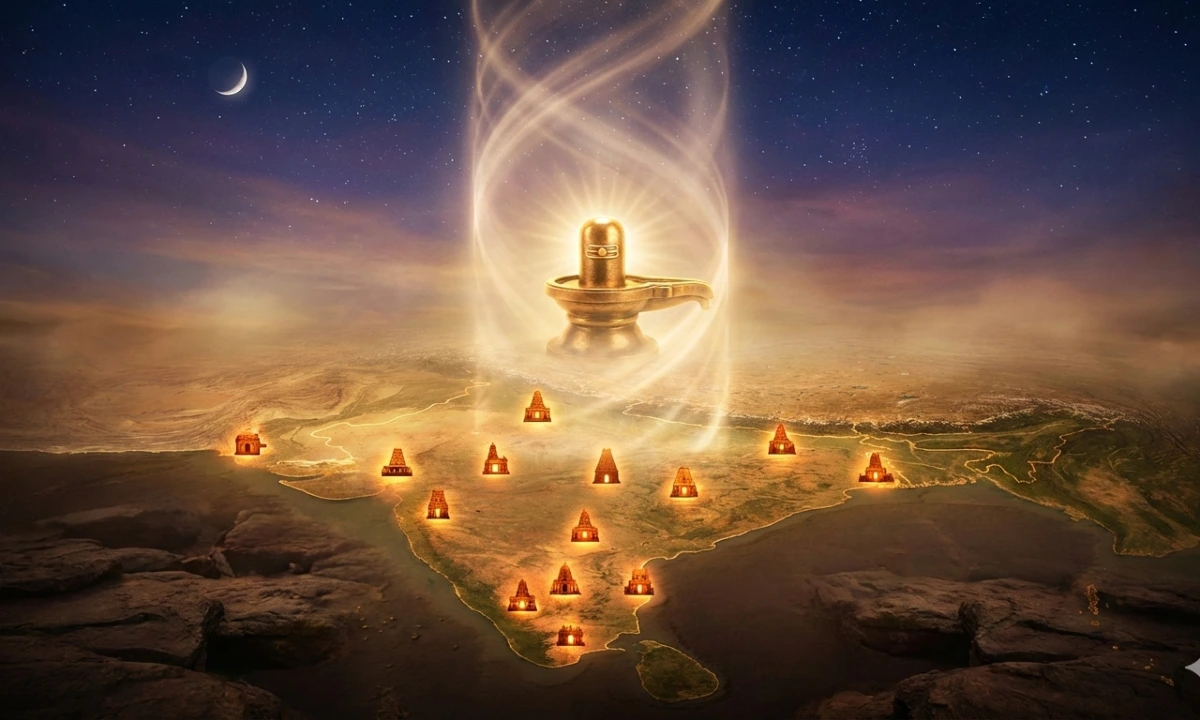
Discover the 12 Jyotirlingas in India with our complete guide. Learn the correct sequence, spiritual benefits, and the fascinating story behind Lord Shiva’s radiant pillars. Plan your Yatra today!
Did you know that Lord Shiva is worshipped in many forms, but the 12 Jyotirlingas in India are considered the most powerful? Unlike ordinary Lingams, a Jyotirlinga is believed to be a self-manifested column of radiant light (Jyoti) where Shiva appeared to bless his devotees.
For centuries, pilgrims have undertaken the Dwadasha Jyotirlinga Yatra to wash away sins and attain inner peace. But where are they located? Which is the oldest? And what is the correct sequence to visit them?
In this guide, we reveal the complete story, the 12 Jyotirlingas in India map details, and a practical itinerary for your spiritual journey.
What is the Story Behind 12 Jyotirlingas?
The origin of the 12 Jyotirlingas in India dates back to a legendary debate between Lord Brahma (the Creator) and Lord Vishnu (the Preserver). According to the Shiva Purana, the two gods were arguing about who was supreme. To settle the dispute, Lord Shiva manifested as a blinding, infinite pillar of light (Jyotirlinga) that pierced the three worlds.
He challenged Brahma and Vishnu to find the ends of this pillar.
Lord Vishnu took the form of a boar (Varaha) and dug deep into the earth but could not find the base.
Lord Brahma flew up as a swan (Hamsa) but could not find the top. However, Brahma lied, claiming he found the summit, offering a Ketaki flower as false witness.
Enraged by the lie, Shiva burst out of the pillar. He cursed Brahma that he would not be worshipped and blessed Vishnu for his humility. The 12 places where this divine light touched the earth became known as the 12 Jyotirlingas in India.
Note: While there are 64 Jyotirlingas in total, these 12 are the Maha Jyotirlingas, the holiest of all.
Where the 12 Jyotirlingas Located in India
Here is the complete list of the 12 Jyotirlingas in India, categorized by their region.
Western India (Gujarat & Maharashtra)
- Somnath (Gujarat): Located near Veraval, this is traditionally considered the first and oldest Jyotirlinga. It has been destroyed and rebuilt 16 times in history.
- Nageshwar (Gujarat): Situated near Dwarka, this temple is believed to protect devotees from all poisons.
- Trimbakeshwar (Maharashtra): Located near Nashik, this unique Lingam has three faces representing Brahma, Vishnu, and Shiva.
- Bhimashankar (Maharashtra): Nestled in the Sahyadri hills near Pune, it is the source of the Bhima River.
- Grishneshwar (Maharashtra): The last of the sequence, located near the famous Ellora Caves in Aurangabad.
Central India (Madhya Pradesh)
- Mahakaleshwar (Ujjain): The only Swayambhu (self-born) Jyotirlinga facing south (Dakshinamurti). It is famous for the Bhasma Aarti (ash ritual).
- Omkareshwar (Khandwa): Located on an island in the Narmada River shaped like the symbol “Om“.
North India (Uttarakhand & Uttar Pradesh)
- Kedarnath (Uttarakhand): Resting in the Himalayas, this is the highest Jyotirlinga, accessible only for six months a year.
- Kashi Vishwanath (Uttar Pradesh): Located in Varanasi (Kashi), the holiest city in Hinduism. It is said that a visit here equals the merit of visiting the other 11 Jyotirlingas.
East India (Jharkhand)
- Vaidyanath (Jharkhand): Also known as Baba Baidyanath Dham in Deoghar, this is where Ravana sacrificed his heads to Shiva.
South India (Andhra Pradesh & Tamil Nadu)
- Mallikarjuna (Andhra Pradesh): Located in Srisailam, it is a rare site that is both a Jyotirlinga and a Shakti Peetha.
- Rameshwaram (Tamil Nadu): The southernmost Jyotirlinga. It was established by Lord Rama to atone for the sin of killing Ravana.
What is the Sequence of 12 Jyotirlingas?
If you wish to chant the names or visit them in the traditional spiritual order, you should follow the Dwadasha Jyotirlinga Stotram written by Adi Shankaracharya.
The Spiritual Sequence:
Somnath (Gujarat)
Mallikarjuna (Andhra Pradesh)
Mahakaleshwar (Madhya Pradesh)
Omkareshwar (Madhya Pradesh)
Vaidyanath (Jharkhand)
Bhimashankar (Maharashtra)
Rameshwaram (Tamil Nadu)
Nageshwar (Gujarat)
Kashi Vishwanath (Uttar Pradesh)
Trimbakeshwar (Maharashtra)
Kedarnath (Uttarakhand)
Grishneshwar (Maharashtra)
Following this sequence for the 12 Jyotirlingas in India is believed to activate the chakras in the human body in a specific alignment.
✅The Journey of River Ganga: From Himalayan Ice to the Bay of Bengal
✅10 Famous Temples In India You Must Visit Before You Die!
Benefits of Visiting 12 Jyotirlingas
Why do millions of people search for the 12 Jyotirlingas in India map every year? The benefits go beyond just tourism.
Destruction of Past Sins: The Shiva Purana states that merely seeing a Jyotirlinga with devotion can burn away the sins of seven lifetimes.
Mental Peace: These temples are built on high-energy fields. Meditating here helps calm the mind and reduce anxiety.
Moksha (Liberation): Visiting Kashi Vishwanath and Rameshwaram specifically is said to grant liberation from the cycle of birth and death.
Fulfillment of Desires: Whether it is health (Vaidyanath) or protection (Mahakaleshwar), each Lingam offers specific blessings.
How to Visit 12 Jyotirlingas in Sequence
Visiting all 12 Jyotirlingas in India in one trip is physically demanding but spiritually rewarding. A practical itinerary usually takes 18 to 25 days.
Suggested Route (Geographical Flow):
Leg 1 (Gujarat): Start at Somnath -> Move to Nageshwar (Dwarka).
Leg 2 (Madhya Pradesh): Travel to Ujjain (Mahakaleshwar) -> Omkareshwar.
Leg 3 (Maharashtra): Visit Trimbakeshwar (Nashik) -> Bhimashankar (Pune) -> Grishneshwar (Aurangabad).
Leg 4 (South): Fly to Hyderabad for Mallikarjuna (Srisailam) -> Train/Flight to Rameshwaram.
Leg 5 (East & North): Fly to Varanasi (Kashi Vishwanath) -> Train to Deoghar (Vaidyanath).
Leg 6 (Himalayas): End your journey at Kedarnath (requires trekking).
Pro Tip: Always check the weather for Kedarnath, as it is closed during winter (November to April).
Quick Facts: 12 Jyotirlingas Comparison Table
| Jyotirlinga | State | Key Feature | Best Time to Visit |
| Somnath | Gujarat | First Jyotirlinga on the coast | Oct – Mar |
| Mallikarjuna | Andhra Pradesh | Shakti Peetha + Jyotirlinga | Sep – Mar |
| Mahakaleshwar | Madhya Pradesh | South-facing, Bhasma Aarti | Oct – Mar |
| Omkareshwar | Madhya Pradesh | Island shaped like ‘Om’ | Oct – Mar |
| Kedarnath | Uttarakhand | Highest altitude temple | May – Jun, Sep – Oct |
| Bhimashankar | Maharashtra | Amidst dense forests | Aug – Feb |
| Kashi Vishwanath | Uttar Pradesh | City of Moksha (Varanasi) | Nov – Feb |
| Trimbakeshwar | Maharashtra | Origin of Godavari River | Oct – Mar |
| Vaidyanath | Jharkhand | Healer of diseases | Oct – Mar |
| Nageshwar | Gujarat | Protector from poison | Nov – Feb |
| Rameshwaram | Tamil Nadu | Established by Lord Rama | Oct – Apr |
| Grishneshwar | Maharashtra | Near Ellora Caves | Oct – Mar |
Did You Know? (Divine Trivia)
Which is the oldest Jyotirlinga?
Somnath in Gujarat is historically and scripturally revered as the first and oldest of the 12 Jyotirlingas in India. It represents the beginning of the Shiva cycle.
Where are the 5 Atma Lingas?
People often confuse these with Jyotirlingas. The 5 Atma Lingas are located in Karnataka. The story involves Ravana trying to bring a Lingam to Lanka. When it was placed on the ground at Gokarna, it could not be lifted. The pieces that scattered became:
- Mahabaleshwar (Gokarna)
- Murudeshwar
- Dhareshwar
- Gunavanteshwar
- Shejjeshwar
Which are the 7 Dham of Shiva?
While “Char Dham” is common, the “7 Dham of Shiva” usually refers to the Sapta Puri (Seven Holy Cities) that are closely associated with Shiva and Moksha. These are Kashi (Varanasi), Kanchi (Kanchipuram), Ujjain (Avantika), Haridwar (Maya), Ayodhya, Mathura, and Dwarka. Among these, Kashi and Ujjain are the primary Shiva Dhams.
FAQs
1. Can I visit all 12 Jyotirlingas in India in one trip?
Yes, but it requires at least 20 days of travel via train or flight. Many travel agencies offer “Dwadasha Jyotirlinga Yatra” packages.
2. Which Jyotirlinga should I visit first?
Traditionally, pilgrims start with Somnath in Gujarat and end with Grishneshwar in Maharashtra.
3. Is there a dress code for the 12 Jyotirlingas?
Yes. Most temples, especially Mahakaleshwar and temples in the South (Rameshwaram, Mallikarjuna), require men to wear dhotis and women to wear sarees or traditional suits. Western wear is often restricted in the inner sanctum.
4. Which is the most powerful Jyotirlinga?
All are equally powerful, but Mahakaleshwar is often feared and revered for its Tantric significance, and Kashi Vishwanath is considered the holiest for salvation.
5. How can I get a 12 Jyotirlingas in India map?
You can easily find a digital map on Google Maps by searching “12 Jyotirlingas list,” or buy a physical pilgrim map at any religious bookshop in Varanasi or Rishikesh.