
To understand the journey of River Ganga, we must follow its path from the icy Himalayan glaciers to the vast Bay of Bengal. This journey tells the story of nature, culture, faith, and life itself.
The River Ganga is not just a river in India—it is an emotion, a belief, and a lifeline for millions of people. Flowing through mountains, plains, villages, cities, and forests, the Ganga has shaped Indian civilization for thousands of years.
In this detailed guide, you will discover the origin of the Ganga River, its sacred history, the states it flows through, major confluences, and how it finally meets the sea.
Why the Journey of River Ganga Is So Special
The Ganga is considered holy in Hinduism and is worshipped as Ganga Maa (Mother Ganga). People believe that her waters purify the soul and wash away sins. Even today, millions depend on the river for drinking water, farming, transport, and religious rituals.
The river travels more than 2,500 kilometers, supporting one of the most densely populated regions in the world. No other river in India holds such deep spiritual, cultural, and geographical importance.
Origin of the Ganga River: Where the Journey Begins
If you search for the journey of River Ganga on a map, you will find its starting point in the Garhwal Himalayas of Uttarakhand.
Gaumukh – The True Source
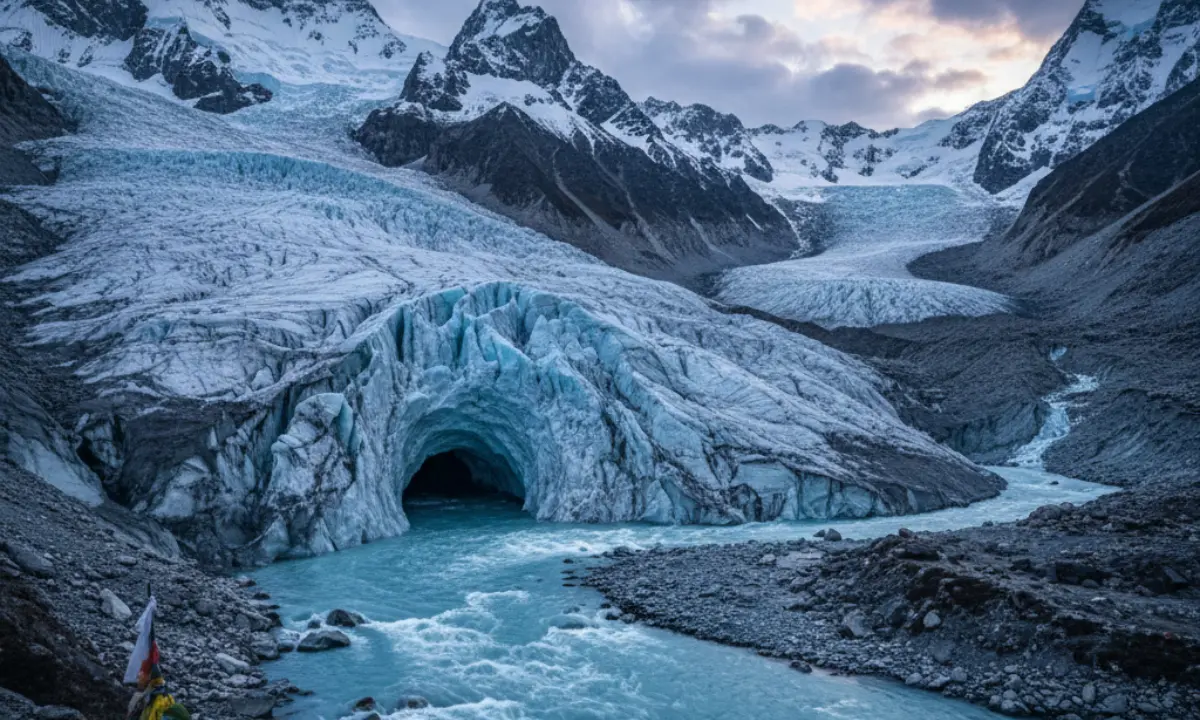
The true origin of the Ganga is Gaumukh, an ice cave at the end of the Gangotri Glacier, located at an altitude of about 13,200 feet. Melted glacier water flows out of this cave, forming a fast-moving river.
At this stage, the river is not called Ganga. It is known as the Bhagirathi River.
The water here is extremely cold, clear, and powerful, rushing down steep mountain valleys.
The Mythological Story of River Ganga
The history of the Ganga River is deeply connected to Hindu mythology.
According to legend, the river originally flowed in heaven. King Bhagiratha performed intense meditation for many years to bring Ganga down to Earth to free the souls of his ancestors.
However, Ganga’s force was so powerful that it could destroy the Earth. To control her flow, Lord Shiva caught the river in his matted hair and released her gently onto the land.
Because of this story:
- Ganga is called a divine river
- Lord Shiva is often shown with Ganga flowing from his hair
- The river at its source is named Bhagirathi, after King Bhagiratha
The Panch Prayag: Five Sacred Confluences
Before becoming the mighty Ganga, several rivers join together in the Himalayas. These sacred meeting points are known as the Panch Prayag (Five Prayags).
Understanding these confluences helps us truly trace the journey of River Ganga.
Vishnuprayag
Here, the Alaknanda River meets the Dhauliganga River near Joshimath.
Nandaprayag
The Alaknanda joins the Nandakini River, increasing its volume.
Karnaprayag
The Pindar River merges with the Alaknanda at this sacred town.
Rudraprayag
The Alaknanda meets the Mandakini River, which flows from Kedarnath.
Devprayag– Birthplace of the Ganga
This is the most important confluence.
Here, the Bhagirathi River meets the Alaknanda River.
From Devprayag onwards, the river is officially called the Ganga.
From Mountains to Plains: The Ganga Enters North India
After Devprayag, the Ganga flows through Rishikesh, a world-famous yoga and spiritual center.
Soon after, it reaches Haridwar, one of the holiest cities in India.
Why Haridwar Is Important
Haridwar marks a major geographical change:
The Ganga leaves the Himalayas
It enters the Indo-Gangetic Plains
Here, the river becomes wider and calmer, making it suitable for irrigation and settlement. This is why many ancient cities developed along its banks.
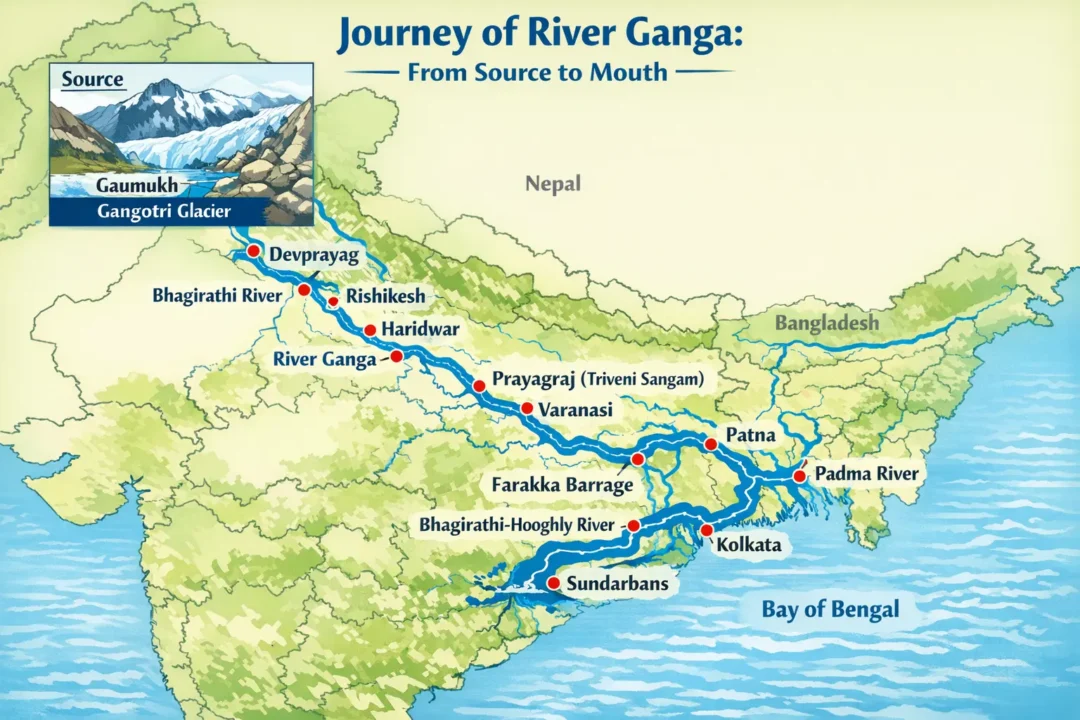
If you look at a Ganga River map from start to end, Haridwar is the turning point of its journey.
Ganga River Flows Through Which States?
As the Ganga moves forward, many large rivers join it, making it stronger and wider.
Major Tributaries of the Ganga
- Yamuna
- Ghaghara
- Gandak
- Kosi
- Son
Indian States the Ganga Flows Through
Uttarakhand
The birthplace of the river, full of glaciers, mountains, and holy towns.
Uttar Pradesh
This state has the longest stretch of the Ganga.
Major cities include:
- Prayagraj (Triveni Sangam)
- Varanasi (Kashi)
- Kanpur
Varanasi is one of the oldest living cities in the world and holds unmatched spiritual importance.
Bihar
The river flows wide and slow here, supporting rich agriculture.
It passes through Patna, the state capital.
West Bengal
This is the final Indian state in the Ganga’s journey before it reaches the sea.
Journey of River Ganga From Source to Mouth
The final phase of the Ganga’s journey begins in West Bengal.
Farakka Barrage: The Big Divide
Near Farakka, the Ganga splits into two major branches:
Bhagirathi–Hooghly River
- Flows south through West Bengal
- Passes through Kolkata
- Finally reaches the Bay of Bengal
Padma River
- Flows into Bangladesh
- Carries the main volume of water
The Ganges Delta: World’s Largest Delta
Before entering the sea, the Ganga creates the Ganges-Brahmaputra Delta, the largest river delta in the world.
The Sundarbans
- World’s largest mangrove forest
- Home of the Royal Bengal Tiger
- UNESCO World Heritage Site
This region plays a vital role in protecting coastal areas from cyclones and floods.
Where Does the Ganga Meet the Sea?
The journey ends at Ganga Sagar, where the river merges with the Bay of Bengal.
This sacred place hosts the Ganga Sagar Mela, one of the largest religious gatherings in India. Pilgrims believe that taking a holy dip here brings salvation.
Importance of the River Ganga Today
The Ganga supports:
- Over 400 million people
- Farming and food production
- Transport and fishing
- Religious and cultural traditions
However, pollution, climate change, and overuse threaten the river. Protecting the Ganga is not just a religious duty—it is essential for India’s future.
Conclusion: The Eternal Journey of Mother Ganga
The journey of River Ganga is more than a physical path from glacier to sea. It is a journey of life, faith, and civilization.
From the frozen silence of Gaumukh, through the crowded ghats of Varanasi, to the wild mangroves of the Sundarbans, the Ganga transforms landscapes and lives.
The Holy Ganga teaches us that just like a river flows endlessly, life too must move forward—connecting past, present, and future.
3 thoughts on “The Journey of River Ganga: From Himalayan Ice to the Bay of Bengal”